Is Selling on Etsy Worth It in 2026? An Honest Reality Check (Fees, Math & Who Should Skip)
Earnrove may earn a commission if you buy through links on this page, at no extra cost to you. See our Affiliate Disclosure.
Here’s what nobody selling you an Etsy course will say out loud: most new Etsy shops make almost nothing in their first year.
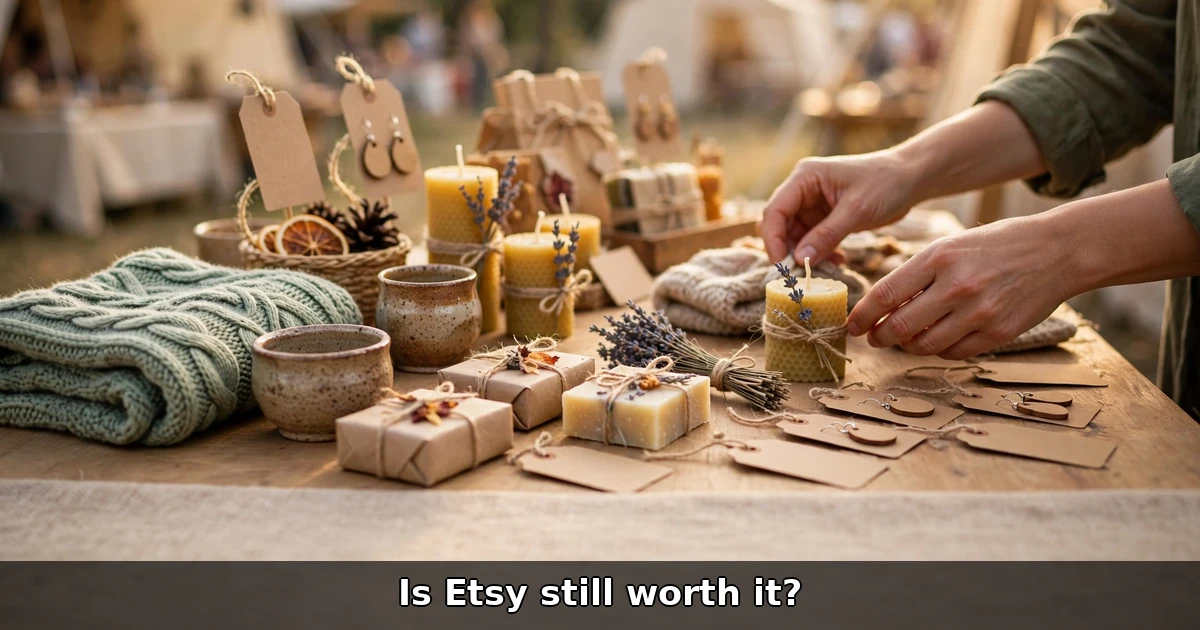
Is selling on Etsy worth it in 2026? The honest answer depends on what you sell, your margins, and whether you’re the kind of seller Etsy rewards. This isn’t another rah-rah “side hustle” pitch, and it isn’t a hit piece. It’s the decision framework I wish someone had handed me before my first listing fee: the real fee math on a $50 sale, the competition numbers, the hidden costs, and a clear-eyed list of who should skip Etsy entirely.
The short answer: Etsy is worth it for some sellers, expensive for others
Etsy works beautifully for one type of seller: someone with a genuinely handmade, vintage, or craft-supply product, priced with real margins, willing to treat listings like a six-month SEO project. That’s the cheapest way to rent access to 86.5 million active buyers without building a website. For everyone else it can be a money pit.
One number captures the tension. Etsy’s FY2025 filing (per Expanded Ramblings, citing Etsy’s SEC 10-K) reports 5.6 million active sellers against 86.5 million active buyers as of December 31, 2025 — roughly 15 buyers per seller, with over 100 million listings competing for attention. Buyers exist. Getting your listings in front of them is the whole game.
What Etsy actually costs in 2026 — the $50 sale walkthrough
Etsy’s famous “6.5% fee” is only one layer. On every US sale, three fees stack — and on some sales, a fourth arrives as a surprise. Here’s what happens when you sell a $50 item with $5 buyer-paid shipping ($55 order total), per Etsy’s published fee schedule as of early 2026 (QuickSync’s October 2026 review).
| Fee | Rate | Math | You pay |
|---|---|---|---|
| Listing fee | $0.20 flat | per listing (re-charged on every sale in multi-quantity listings and every auto-renewal) | $0.20 |
| Transaction fee | 6.5% | 6.5% × $55 (item price plus shipping charged) | $3.58 |
| Payment processing (US) | 3% + $0.25 | 3% × $55 + $0.25 | $1.90 |
| Total Etsy fees | — | before any product cost, shipping label, or ads | $5.68 |
That’s 10.3% of the order value — on a platform marketed as “6.5%.” If an Offsite Ad drove the sale, add another 12% or 15% of the order total (more below).
Two details sellers always miss. First, the 6.5% applies to the shipping you charge, not just the item. Second, every unit sold in a multi-quantity listing re-triggers the $0.20, and listings auto-renew at $0.20 every four months whether they sell or not. A dead listing sitting for a year costs you $0.60 for the privilege of being invisible.
Run your own numbers with our Etsy true profit calculator — and for every fee line by line, our 2026 Etsy fee breakdown.
The cheap-item problem: fees bite harder the lower your price
Those flat fees don’t shrink when your price does. On a $15 item the same stack costs about $1.88 — roughly 12.5% — and past 15% on a $5 item. The platform punishes bargain-bin pricing harder than almost any marketplace.
The Offsite Ads surprise: 12% vs 15%
This is the fee that turns Etsy fans into ex-Etsy sellers. When Etsy runs your listings as ads off Etsy — Google Shopping, Instagram, Pinterest — and that click becomes a sale within 30 days, you owe an extra fee on top of everything above:
- 15% if your shop made under $10,000 in the last 365 days — you can opt out, but most sellers don’t realize it’s on until the first surprise bill
- 12% once you’ve crossed $10,000 — and at that point it’s mandatory, for the life of the shop; there is no opt-out
That $55 order suddenly costs $5.68 in base fees plus $6.60–$8.25 in Offsite Ads fees — your effective cut approaches 20–25%. We unpack the whole controversy in our Etsy Offsite Ads fee guide. Read it before your first sale, not after your first surprise.
The competition reality check
Let’s be blunt about the “why are sellers leaving Etsy” question. They’re not leaving because Etsy is a scam — they’re leaving because of a squeeze from three sides at once.
1. Fee stacking. The stack above, plus optional Etsy Ads and — in some countries — a small regulatory operating fee, can push an attributed sale toward 20%.
2. Crowded niches. Six categories generate nearly 90% of Etsy’s sales — Home & Living (~34% alone), Jewelry & Accessories, Apparel, Craft Supplies, Paper & Party Supplies, and Toys & Games (Printful’s 2026 roundup, citing Etsy data). Look like everything else in one of those and you’re competing on price — which favors the cheapest, not the best.
3. A slowing marketplace. Etsy’s own reports show active buyers down roughly 5% year over year — with a new CEO (Kruti Patel Goyal) taking over January 1, 2026. A shrinking buyer pool plus millions of sellers equals a tougher hunt for every sale.
None of this means “don’t go.” Etsy rewards sellers who differentiate and punishes sellers who copy.
Hidden costs nobody mentions
Beyond the fee table, these expenses quietly decide whether your shop is a business or an expensive hobby:
- Time. Photography, SEO-optimized titles and tags, customer messages, packaging. A single listing done right takes hours — multiply by 30–50 listings to look established.
- Photography. On Etsy, photos are your storefront. Mediocre photos in a sea of gorgeous ones = no clicks, no sales.
- Shipping gap. The buyer pays you for shipping; you pay the carrier. The difference between the two is yours to absorb.
- Setup and reserves. New shops pay a one-time setup fee (~$15–$29, introduced 2024), and Etsy can hold a percentage of your funds in reserve, especially for new shops. Your “profit” isn’t always your cash.
- No customer list. You can’t export buyers’ emails. You’re renting customers, not owning them — which matters the day you consider leaving.
Who Etsy is genuinely great for
After all that, let’s be fair. Etsy is genuinely one of the best places on the internet to sell if you check most of these boxes:
- Handmade or vintage sellers with a real craft — Etsy buyer intent is “unique, not mass-produced,” which is exactly your product
- Sellers with no audience — 86.5 million buyers is traffic you could never afford to build yourself
- Test-and-learn sellers — launching costs almost nothing, so it’s the cheapest way to learn if anyone wants your product
- Digital product sellers with strong SEO skills — no shipping, no inventory, but price above the bargain bin
If that’s you, plug your real material and labor costs into the Etsy true profit calculator. If the margin survives the fee stack with room to spare, Etsy is a legitimate business home.
Who should SKIP Etsy (the honest part)
This is the section most “Etsy guru” content skips. Skip Etsy — or at least don’t start there — if any of these describe you:
- You’re reselling generic mass-produced goods. It’s against Etsy’s rules (handmade, vintage 20+ years, or craft supplies only) — borderline shops live one report away from suspension.
- Your margins are under 40%. The ~10–11% fee stack plus your real costs leave you working for free. Raise prices or sell elsewhere.
- You already have an audience. Bring your own traffic and your own site keeps nearly 97% after card fees — Etsy takes a tenth and adds nothing.
- You sell low-margin, high-volume items. Dollar-store economics plus percentage fees equals a hamster wheel. Volume doesn’t fix a broken margin.
- You need results this month. Etsy’s search rewards established shops with reviews and history. New shops usually need months of listing SEO. Expecting rent money in week three is how disappointment compounds.
- You refuse to learn listing SEO. Titles, tags, attributes, photos — this is the job on Etsy. The craft is 30% of the business; being found is the other 70%.
And one more uncomfortable truth: if you’re charging $12 for something that takes three hours to make, Etsy won’t save you. No marketplace fixes a pricing problem.
Etsy vs. your own website: the real comparison
People frame this as a rivalry, but smart sellers treat it as a sequence. Here’s the honest trade:
- Etsy wins at the start: zero setup complexity, instant buyer traffic, built-in trust, payments handled. You pay ~10–11% of every sale and own zero customer data.
- Your own store wins later: roughly $39/month plus ~2.9% + $0.30 in card processing — far cheaper per sale once volume grows — and you own the relationship. But you bring your own traffic, which costs ad spend or years of content.
The pattern that works: validate on Etsy, then open your own site once you have proof and repeat buyers. Plenty of six-figure sellers run both — Etsy for discovery, their site for margin.
A 3-question decision framework
Answer these three and you’ll have your answer:
1. Can your price survive the fee stack with 40%+ margin left? Run one real item through the Etsy true profit calculator — item cost, labor, packaging, shipping gap, all of it. If no, fix the pricing first, wherever you sell.
2. Do you have traffic, or do you need Etsy’s? No audience and no ad budget? Etsy’s 86.5 million buyers are worth the 10%. Already have 50K TikTok followers? You may be donating margin for nothing.
3. Will you spend six months learning Etsy’s search? Winners treat it like a part-time job — better photos, sharper titles, tested tags. If that sounds miserable, this marketplace will feel like a trap.
Three yeses? Open the shop. Any no? Fix that first — the fees aren’t the problem, the fit is.
FAQ
How much does Etsy take from a sale in 2026? On a typical US sale: $0.20 listing fee + 6.5% transaction fee (on item price plus shipping) + 3% + $0.25 payment processing — roughly 10–11% of the order before product costs. If an Offsite Ad drove the sale, add 12% or 15% more. A one-time shop setup fee (~$15–$29) applies to new shops.
Is Etsy worth it for small sellers / beginners in 2026? It can be — Etsy is the cheapest way to test whether anyone wants your product. But expect months before meaningful sales, and price with real margins: the fee stack punishes cheap items hardest.
Why are sellers leaving Etsy? Common complaints: fee stacking (up to ~20–25% on Offsite-Ad sales), fierce competition in top categories, mandatory Offsite Ads past $10,000/year, and a slowing buyer base per Etsy’s own reports. Sellers who differentiate and own their margins tend to stay.
Is Etsy better than Shopify for a new store? For a new seller with no audience, yes — instant buyer traffic with near-zero setup cost. For a seller with existing traffic, Shopify is usually cheaper per sale and you own your customer data. The most common winning pattern is both.
Can you actually make money on Etsy in 2026? Yes, but honestly: most new shops earn little in their first months. Sellers who make real money share three traits — differentiated products, prices that survive the fee stack, and months of consistent listing SEO. It is a business, not a lottery ticket.
What sells best on Etsy right now? Top categories: Home & Living (~34% of sales), Jewelry & Accessories, Apparel, Craft Supplies, Paper & Party Supplies, Toys & Games. Personalized items and clear niches outperform generic listings — though competition inside them is fierce.
What are the downsides of selling on Etsy? The fee stack (~10–11% before ads), the Offsite Ads surprise (12–15% on attributed sales), brutal competition in big niches, no customer email list, platform dependence (policy changes, reserves), and the time cost of listing SEO and photography.
Is it better to sell on Etsy or your own website? Depends on your stage. Start on Etsy for cheap validation; add your own website once you have proven products and repeat buyers — per-sale costs drop and you own the relationship.
Estimates based on Etsy’s published fee schedule; Etsy changes fees — always confirm the current schedule before listing. Nothing here is tax or financial advice.
Before you commit to any single marketplace, zoom out: JobyRoz breaks down real side hustles and earning paths in plain language, and while you’re mapping the dream, Furveko has the pet guides that keep your four-legged studio assistant happy through every late-night listing session.