
How to Check eBay Sold Listings: Price Anything Like a Pro (2026)
Earnrove may earn a commission if you buy through links on this page, at no extra cost to you. See our Affiliate Disclosure.
Learning how to check eBay sold listings is the highest-value skill in eBay selling. Active listings show what sellers hope to get. Sold listings show what buyers actually paid.
Why Sold Listings Beat Everything Else
Recorded transactions — real buyers, real money, last ~90 days. Check before spending a dollar on inventory.
How to Check eBay Sold Listings on Desktop (Step by Step)
- Go to eBay.com, search your item (brand + model + details).
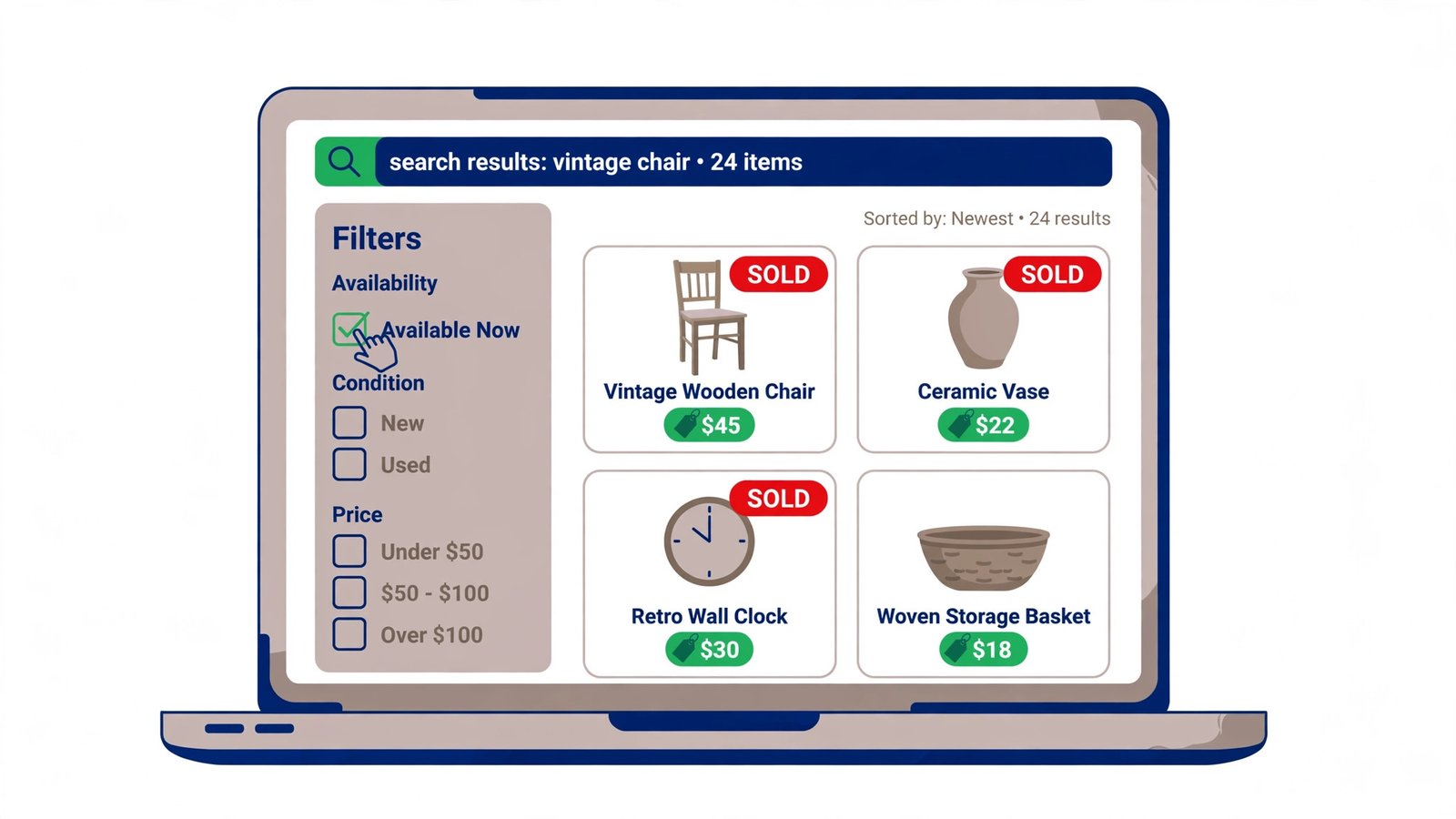
- Left sidebar → “Show only” → tick “Sold items”.
Pro move: also check “Completed items” separately to see unsold listings — the gap shows the real market ceiling.
Refine Like a Pro
Sort Price highest first; sort End date recent first; use category and condition filters.
How to Check Sold Listings on Mobile
eBay app → search → Filter → “Show only” → Sold items → Show results. Perfect for thrift-store checks.
How to Read Sold Listings Data Correctly
Green Flags
3+ recent sales in 30 days; consistent prices; multiple auction bids; fast sell-through.
Red Flags
No recent sales; wildly scattered prices; only old sales; Best Offer sales (displayed price may be asking price).
The 3-Sale Rule
Find at least 3 comparable recent sales, average them, subtract fees and shipping — that is realistic revenue.
4 Mistakes That Make Sold-Listing Research Misleading
- Comparing different conditions.
- Ignoring shipping in the comp.
- Trusting one sale.
- Forgetting fees ($50 comp ≈ $43 after eBay’s cut).
Sold Listings for More Than Pricing
Mine them for title keywords, photo styles, listing format (auction vs Buy It Now), seasonality.
Spotting Trends in Sold Listings
Sell-through rate (70%+ = strong demand), price direction, seasonality (buy off-season, sell in-season), title patterns.
FAQ: eBay Sold Listings
How far back do eBay sold listings go?
Approximately the last 90 days.
Why do some sold listings show a different price than paid?
Best Offer sales may display the asking price, not the accepted offer.
Can I see sold listings without an eBay account?
Yes — publicly visible, no sign-in needed.
What is the difference between “sold” and “completed” listings?
Completed = everything ended (sold + unsold). Sold = found a buyer. For pricing, sold is what matters.
How many sold comps do I need before buying inventory?
Minimum three recent comparable sales; five to ten is better.
Do sold listings work for rare items?
Partially — use closest similar items, widen the set, adjust for condition/rarity.
Research Sold Listings in One Click
🚀 Check Sold Listings in One Click — Free
- ✅ Sold-price checker — jump straight to sold listings for any keywords
- ✅ Free profit calculator — turn comp prices into net profit instantly
- ✅ AI title optimizer — borrow winning keywords for your own titles
Install eBay Seller Toolkit — Free
Free Chrome extension · No account needed · Your data stays on your device
Worked Example: Turning Three Comps Into a Price
Put the 3-sale rule to work on a real item. Say you found a used pair of headphones at a thrift store and three recent sold listings for the same model in the same condition show $48, $52, and $50. Add them together — $48 + $52 + $50 = $150 — and divide by three to get an average comp of $50. That $50 is the market price, not your profit. This guide’s rule of thumb is that a $50 comp is about $43 after eBay’s cut, so start from $43, not $50, when you decide what the item is worth to you. If you paid $20 for the headphones, your margin before shipping is $43 − $20 = $23. If you paid $40, your margin is only $3 before shipping, and one return or one shipping miscalculation wipes it out. The same $50 average tells a very different story depending on what you paid, which is why the fee step matters more than the comp average itself.
Now check the demand behind those three sales before you buy. All three sold within the last 30 days, inside eBay’s roughly 90-day sold-listing window, so they are fresh comps — not stale prices from a different season. Next, look at the sell-through rate the way this guide describes it: if 10 listings for this model ended in the same period and 7 of them sold, the sell-through rate is 7 ÷ 10 = 70%, which meets the 70%+ mark for strong demand. If only 3 of 10 sold, the rate is 30%, and the three sales you found are the exceptions, not the rule — the other seven listings sat unsold, probably because their prices were too high or their photos were weak. A $50 average with 70% sell-through is a buy signal; the same $50 average with 30% sell-through is a warning to price below the average or to walk away.
Finally, test the comps the way this guide warns you to. Check that all three were the same condition as yours — a new-in-box sale does not price a used pair — and check whether any of them was a Best Offer sale, because Best Offer sales may display the asking price, not the accepted offer. If the $52 comp was a Best Offer listing that started at $52, the buyer may have paid less, so treat $52 as a ceiling, not a fact. If one comp is far from the others — say $48, $50, and $85 — do not average all three and call it $61. The $85 sale is probably a different bundle, a rarer variant, or a one-off; set it aside, average the two that match, and look for a third comp that looks like yours. Three comparable recent sales, averaged, minus fees and shipping, is the whole method — and the $50 example above is what it looks like when you actually run it.
More Sold-Listing Questions, Answered
What if I can only find one or two comps?
Do not price from one sale. One sale can be a fluke, a Best Offer, or a listing with a flaw yours does not have. Widen the search: try the same model in a nearby condition, the same item in a different colour, or a search with fewer keywords, until you have at least three comparable recent sales. If you still cannot find three, the item is thinly traded and you should price conservatively — list it, watch it, and treat your own first sale as the fourth comp. The guide’s minimum is three recent comparable sales, and five to ten is better, precisely because one or two sales leave too much room for a wrong price.
Should I price at the average comp, above it, or below it?
Start at the average if the sell-through rate is 70% or higher and your condition matches the comps. Price below the average if sell-through is weak, your condition is worse, or you need a fast sale. Price above the average only if yours is clearly better — new instead of used, complete with box and accessories, or a rarer variant — and even then, keep it close, because buyers can see the same sold listings you can. Remember the fee step too: a $50 comp is about $43 after eBay’s cut, so pricing at the average already leaves you less than the comp price. If you need $43 in hand, you have to list above $50, not at it.
How do I use sold listings when prices are all over the place?
Scattered prices are a red flag, not a pricing guide. When comps range from $30 to $90 for what looks like the same item, the listings are not actually the same — different conditions, different bundles, different variants, or Best Offer sales displaying asking prices. Sort the results by price, highest first, then by end date, most recent first, and read the titles one by one until the differences show up. Group the comps that match your item and ignore the rest. If no group has three sales, you do not have a price yet — you have a research problem, and the answer is a narrower search, not a guess in the middle of the range.


One Comment