How to Write eBay Titles That Sell: The 80-Character Formula (2026)
Earnrove may earn a commission if you buy through links on this page, at no extra cost to you. See our Affiliate Disclosure.
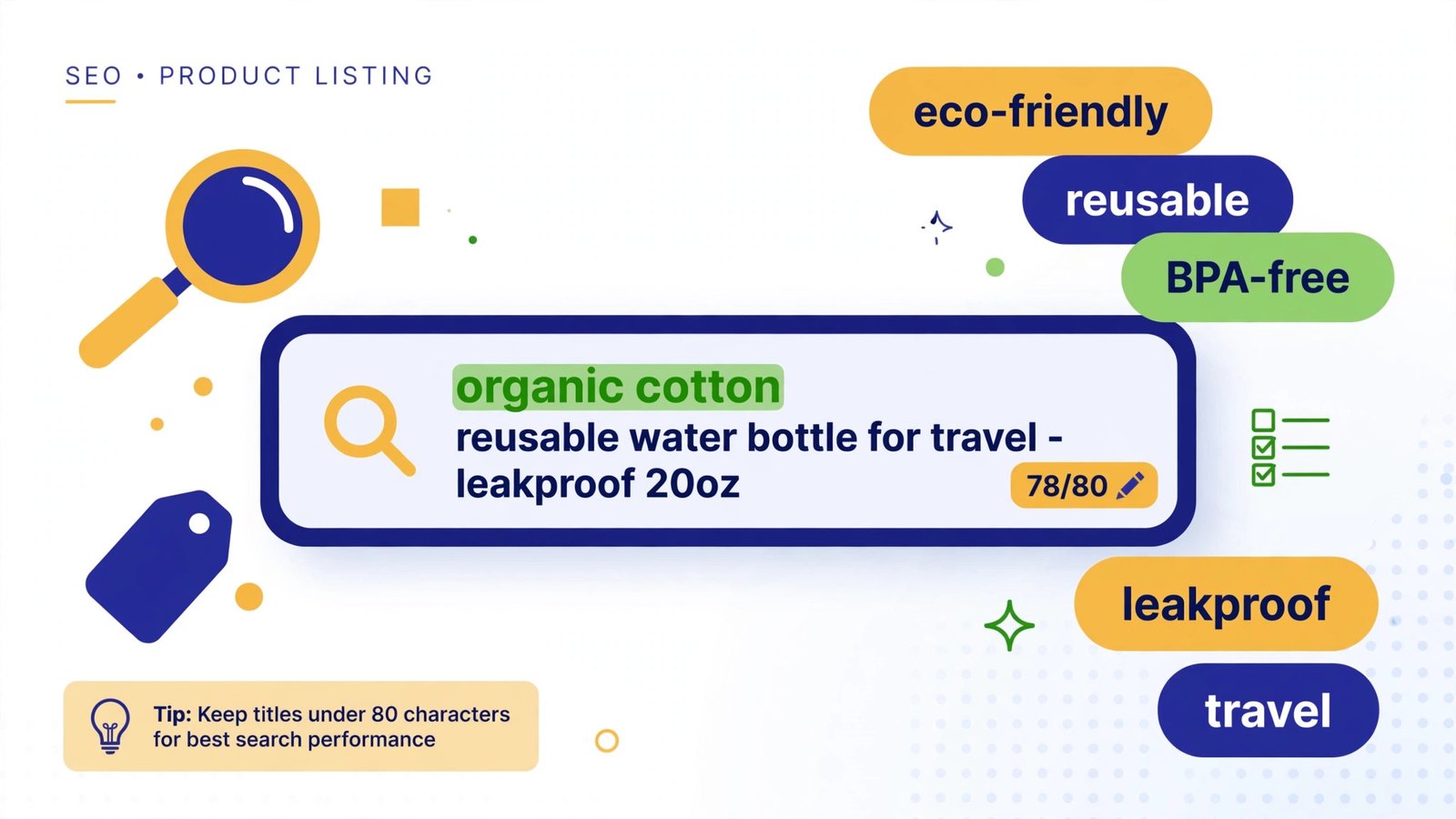
If you want to learn how to write eBay titles that sell, start here: your title is the single most important part of your listing. eBay gives you exactly 80 characters, and its search algorithm matches those characters literally against what buyers type.
Why Your eBay Title Matters More Than Anything Else
eBay’s search (Cassini) rewards literal keyword matching far more than Google does. Three facts: 80 characters maximum. Keywords first — eBay weighs the start more. Buyers skim — clear keyword-rich titles win clicks on mobile.
The 80-Character Title Formula
[Brand] [Product Name + Model] [Key Specs] [Condition]
| Component | Characters | Example |
|---|---|---|
| Brand | 5–15 | Nike, Sony, LEGO |
| Product / model | 10–25 | Air Max 90, WH-1000XM4 |
| Key specs | 15–25 | Men’s Size 11, 128GB Unlocked |
| Condition | 3–10 | New, Vintage, Sealed |
Example (78 chars): Sony WH-1000XM4 Wireless Noise Canceling Headphones Black - Excellent Condition
What to Include in eBay Titles
Brand name first, exact product/model, key variants (size, color, storage), condition, 1–2 high-traffic secondary keywords.
What NOT to Put in eBay Titles
Filler hype (“LOOK!”, “WOW”), “FREE SHIPPING” (eBay shows it as a badge), ALL CAPS, emoji/symbols (not indexed), other brands’ names (policy violation), keyword stuffing.
3 Real Examples: Bad Titles vs. Optimized Titles
Example 1: Sneakers
Bad: AWESOME NIKE SHOES MENS SIZE 11 L@@K! → Optimized (76): Nike Air Max 90 Mens Running Shoes Size 11 White Black DH8010-100 New In Box
Example 2: iPhone
Bad: GREAT PHONE FOR SALE!!! → Optimized (71): Apple iPhone 12 Pro 128GB Graphite Unlocked - Excellent Condition
Example 3: Vintage Jacket
Bad: Cool old jacket vintage look → Optimized (74): Vintage 90s Levi’s Denim Trucker Jacket Mens Medium Blue - Y2K Retro
Research Titles Before You Write: The Sold-Listings Method
Search your item on eBay → filter Sold items → sort Price highest first → study winning titles’ structure.
Don’t Forget Item Specifics
Fill every structured field (Brand, Size, Color) — filters hide listings with blanks.
3 Copy-Paste Title Templates
Electronics: [Brand] [Model] [Storage/Size] [Color] [Carrier] - [Condition].
Clothing: [Brand] [Garment] [Size] [Color] [Era/Style] - [Condition].
Collectibles: [Year] [Brand] [Item] [Set/Number] [Variant] - [Condition].
One More Tip: Refresh Stale Titles
Listings unsold 30+ days: rewrite the title with fresh keyword research before relisting.
FAQ: eBay Titles
How many characters can an eBay title be?
80 maximum — use as many as possible with relevant keywords.
Should I use all caps in my eBay title?
No — harder to read, looks spammy.
Do emojis help eBay titles?
No — eBay search does not index them.
What are the most important keywords in an eBay title?
Brand, exact product/model, key variant — put them first.
Can I mention other brands in my title?
Avoid it — can violate eBay policy.
How do I find keywords buyers actually search?
Sold listings, sorted by highest price — study winning titles.
Write Better Titles in Seconds
🚀 Generate eBay Titles That Get Found — Free
- ✅ AI title optimizer — keyword-rich 80-character titles in one click
- ✅ Free profit calculator — know your exact fees before you list
- ✅ Sold-price checker — research winning titles from real sold listings
Install eBay Seller Toolkit — Free
Free Chrome extension · No account needed · Your data stays on your device
Worked Example: Building a Title to Exactly 76 of 80 Characters
Take the vintage jacket from Example 3 above and rebuild its title from scratch using the formula, counting as you go. The bad title is Cool old jacket vintage look. Count it: Cool is 4 characters, a space makes 5, old is 3 more for 8, a space makes 9, jacket is 6 more for 15, a space makes 16, vintage is 7 more for 23, a space makes 24, and look is 4 more for 28. Twenty-eight characters used, 52 wasted — and the title contains no brand, no size, no colour, and no era, so it matches almost nothing a buyer would type. Now build the replacement with the formula: brand, product and model, key specs, condition. Start with the brand and era: Vintage 90s Levi's is 18 characters — Vintage is 7, a space makes 8, 90s is 3 more for 11, a space makes 12, and Levi’s is 6 more for 18. Add the product: a space makes 19, Denim is 5 more for 24, a space makes 25, Trucker is 7 more for 32, a space makes 33, and Jacket is 6 more for 39. Add the key specs: a space makes 40, Men’s is 5 more for 45, a space makes 46, Large is 5 more for 51, a space makes 52, and Blue is 4 more for 56. Add the condition words: a space makes 57, Excellent is 9 more for 66, a space makes 67, and Condition is 9 more for 76. The finished title is Vintage 90s Levi's Denim Trucker Jacket Men's Large Blue Excellent Condition — 76 characters of 80, with four to spare.
Read that finished title the way a buyer reads it, and the formula does its work in order. The first words are the ones eBay weighs most: the brand, Levi’s, lands in the first 18 characters, and the product, a denim trucker jacket, follows immediately. The key specs — Men’s, Large, Blue — are the words a buyer uses to narrow a search, and they sit in the middle where a skim-reading buyer still sees them. The condition words come last because they matter least for matching, but they still matter: a buyer choosing between two jackets at the same price picks the one that says Excellent Condition. Nothing in the title is filler. There is no LOOK, no WOW, no FREE SHIPPING, and no emoji — every one of the 76 characters is a word a buyer might type, which is exactly the test the section above sets. If a word in your title is not something a buyer would search for, it is taking space from a word they would.
Now use the four spare characters. Four characters is not enough for another real keyword — most useful words are longer — so the right move is to leave them spare rather than to squeeze in a filler word that adds nothing. The opposite mistake is just as common: a title that runs past 80 characters gets cut off, and eBay truncates it, so the words at the end — usually the condition words — are the ones buyers never see. To check your own title, do what this example did: write it out, count it in chunks, and add the chunks together. If you are over 80, cut a low-value word from the middle, not the brand from the front — the brand is the most heavily weighted part of the title. If you are under 60, you are leaving search traffic on the table: go back to sold listings, sort by highest price, and borrow one more spec word from the winning titles. The jacket above went from 28 characters to 76, and the difference is not length for its own sake — it is 48 more characters of words buyers actually search for.
More eBay Title Questions, Answered
Should I repeat the brand in the title if it is already in Item Specifics?
Yes. Item Specifics are filters, and the title is what eBay search matches — the two do different jobs. The section above says to fill every structured field because filters hide listings with blanks, and it also says to put the brand first in the title because eBay weighs the start more. A buyer searching for Levi’s will find your jacket because Levi’s is in the title; a buyer filtering by size will find it because the size is in Item Specifics. Leaving the brand out of the title to save characters costs you the search, which is the part that brings the buyer to the listing in the first place.
How often should I rewrite a title?
Rewrite it when the listing has been unsold for 30+ days, using fresh keyword research before relisting — that is the tip in the section above, and it is the only schedule in this guide. Do not rewrite a title every day. A title needs time to be found, and changing it constantly means you never learn whether the title or the price was the problem. When you do rewrite, go back to sold listings first: search your item, filter Sold items, sort by price highest first, and study the titles that actually sold. If the winning titles use a word yours does not — a model number, a size, a colour — that word is the first thing to add.
What if my item has no brand?
Use the formula anyway, starting with the words buyers search for instead of a brand name. The formula is brand, product and model, key specs, condition — but for an unbranded item, the product and its key specs move to the front. A handmade item, a vintage piece with no label, or a generic accessory should still lead with the product type and its most important variant: size, colour, material, or era. The rule is the same as for a branded item: every word should be something a buyer would type, the most important words go first, and the title should use as much of the 80 characters as possible with relevant keywords. What you must not do is fill the space with hype — LOOK, WOW, and all-caps do not help an unbranded item any more than they help a branded one.