What Sells Best on eBay for Beginners: 2026 Guide to Your First Profits
Earnrove may earn a commission if you buy through links on this page, at no extra cost to you. See our Affiliate Disclosure.
So you want to start selling on eBay — the first question is what sells best on eBay for beginners. Pick wrong and you sit on dead inventory; pick right and your first sales teach you the business.
The Beginner’s Golden Rule: Start Small, Learn Fast
First goal: learning the system while risking almost nothing — items under $30.
5 Best Categories for eBay Beginners
1. Vintage & Thrifted Clothing
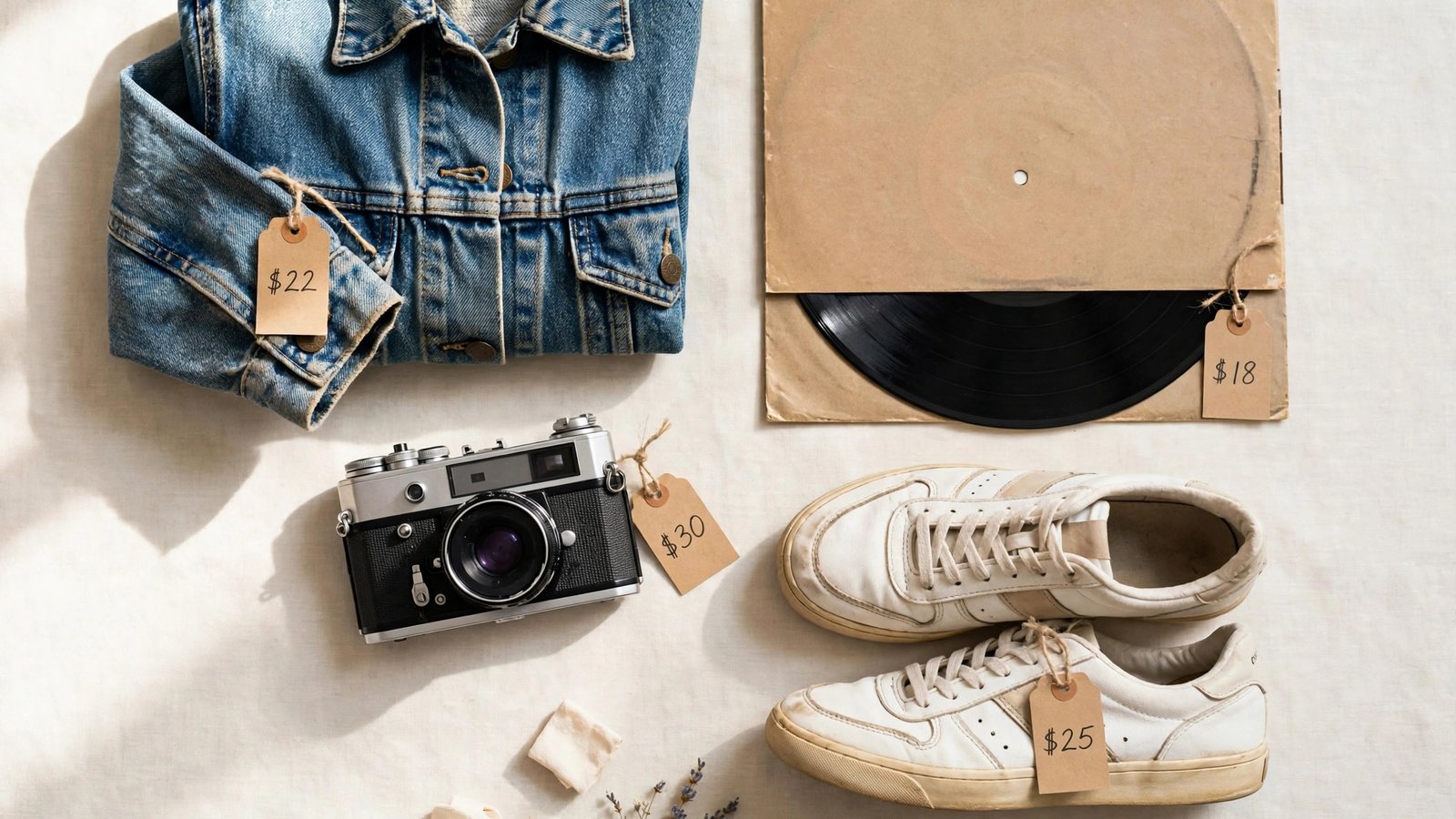
Band tees, Levi’s denim, 90s/Y2K streetwear — cheap sourcing, light shipping.
2. Small Collectibles
Trading cards, coins, figurines — passionate buyers, cheap padded-envelope shipping.
3. Books, Media & Retro Games
Standardized products, simple to list; grade condition honestly.
4. Small Home & Kitchen Items
Brand-name gadgets, decor — easy photos, easy packing. Avoid heavy items.
5. Phone Accessories & Small Electronics Accessories
Cases, chargers, earbuds — high demand, tiny and light. Avoid actual devices early (return scams).
What Beginners Should AVOID Selling
High-end electronics (return scams), designer bags/sneakers (counterfeit disputes), anything over $200, heavy items, restricted categories.
How to Validate Any Product Before You List It
Search item on eBay → tick Sold items → look for: a few sales in last 30 days, consistent prices, learnable titles. No recent solds = no demand — walk away.
Price It Right: The Fee Reality Check
Pricing formula: Minimum price = item cost + shipping cost + eBay fees + your profit target. Roughly 13.6% final value fee + $0.30–$0.40 per order (2026 estimates; verify on eBay’s official fee page).
Your First 30 Days: A Simple Plan
Week 1: List 5–10 items you own. Week 2: Study views and sold comps. Week 3: Source 10–20 thrifted items in one winning category. Week 4: Review, double down on winners.
Free Tools That Make Beginners Faster
Sold listings (free validation), a fee calculator, a title helper — systematize all three.
FAQ: Selling on eBay as a Beginner
Is it free to sell on eBay?
Mostly — up to 250 free listings/month; final value fee (~13.6%) only when items sell.
How much money do I need to start?
$0 selling own items; $50–$100 for thrifted inventory.
What sells fastest for beginners?
Thrifted brand clothing, small collectibles, books/media — items under $30 move fastest.
How do I know what price to set?
Sold listings median, slightly below moves faster; subtract fees and shipping first.
Can I sell without a store subscription?
Yes — optional, makes sense at higher volume.
What is the biggest beginner mistake?
Pricing from active listings instead of sold listings.
Start With the Right Tools
🚀 The Free Toolkit for New eBay Sellers
- ✅ Sold-price checker — validate any product idea against real sold listings
- ✅ Free profit calculator — see fees and net profit before you commit
- ✅ AI title optimizer — listing titles that get found from day one
Install eBay Seller Toolkit — Free
Free Chrome extension · No account needed · Your data stays on your device
Worked Example: What a $25 Sale Really Leaves You
Run the fee reality check on a typical beginner sale. Say you buy a thrifted brand jacket for $10 and list it for $25 — inside the under-$30 rule from the golden rule above. The final value fee is about 13.6% of $25, which is $3.40, plus the per-order fee of $0.30–$0.40. Using $0.40, the total fee is $3.40 + $0.40 = $3.80, and you keep $25 − $3.80 = $21.20 before shipping. Subtract the $10 you paid for the jacket and your profit before shipping is $21.20 − $10 = $11.20. That is the number that matters: not the $25 sale price, and not even the $21.20 after fees, but the $11.20 left after the item cost. If shipping costs eat more than $11.20, the sale loses money; if shipping is light — a jacket in a poly mailer, for example — most of that $11.20 stays with you.
Compare that with a $15 sale to see why the per-order fee matters. A $15 item carries a final value fee of about 13.6% of $15, which is $2.04, plus $0.40, for a total fee of $2.44. You keep $15 − $2.44 = $12.56 before shipping. If you paid $5 for the item, your profit before shipping is $12.56 − $5 = $7.56. Now compare it with a $60 sale, which is outside the under-$30 beginner rule: the final value fee is about 13.6% of $60, which is $8.16, plus $0.40, for a total of $8.56, and you keep $51.44 before shipping. The fee itself is bigger in dollars, but it is the same share of the price — about 14% once the per-order fee is counted — because the $0.40 matters less as the price rises. The reason this guide still tells beginners to stay under $30 is not the fee rate; it is the risk. A $15 mistake costs $5 of inventory, while a $60 mistake costs far more, and the learning is the same either way.
Scale the $25 example up to the $50–$100 thrift budget from the FAQ and the plan comes into focus. Spend $50 on five items at $10 each, and sell all five for $25 each. Your total revenue is 5 × $25 = $125. Each sale carries $3.80 in fees, so five sales carry 5 × $3.80 = $19.00 in fees, and you keep $125 − $19 = $106 before shipping. Subtract the $50 you spent on inventory and your profit before shipping is $106 − $50 = $56. That is five items, five listings, and one $50 budget turning into $56 of profit — if all five sell at $25, which is why the validation step matters. Check sold listings first: look for a few sales in the last 30 days at prices close to yours before you spend the $50. If the comps show the jacket selling for $18 instead of $25, rerun the numbers: a $18 sale carries a fee of about 13.6% of $18, which is $2.45, plus $0.40, or $2.85, so you keep $15.15, and your profit on a $10 item is $5.15 before shipping — still a profit, but half of what the $25 price promised, and a very different reason to buy the inventory.
More Beginner Questions, Answered
How many items should I list first?
Follow the first-30-days plan in this guide: list 5–10 items you already own in Week 1. Five to ten listings are enough to learn the system — photos, titles, shipping, and the sold-listings check — without spending a dollar on inventory. If you start with the $50–$100 thrift budget instead, the same 5–10 items is the right size: five items at $10 each is $50, and ten items at $10 each is $100. Do not list 50 items in your first week. With up to 250 free listings a month, the listings themselves are not the constraint; your time, your photos, and your ability to ship them are.
What if my first item does not sell in a week?
Do not panic and do not relist it at the same price. Go back to sold listings and check three things: did similar items actually sell in the last 30 days, at what price, and were their titles and photos better than yours? The most common beginner mistake — pricing from active listings instead of sold listings — is usually the cause: active listings show what sellers hope to get, not what buyers pay. Price at or slightly below the sold-listings median, check that your title uses the words buyers search for, and make sure your first photo is clear and bright. If similar items sold and yours did not, the listing is the problem, not the product. If nothing similar sold at all, the product was the wrong pick, and the lesson cost you nothing if it was an item you already owned.
Can I sell items over $30 as a beginner?
You can, but the guide’s advice is to learn first on items under $30, and the fee math shows why the stakes rise. On a $60 sale the fees are about $8.56 and you keep $51.44 before shipping, so a pricing mistake, a return, or a shipping error costs far more dollars than the same mistake on a $15 sale, where the fee is $2.44 and you keep $12.56. Higher-priced items also carry more risk in the categories this guide tells beginners to avoid: high-end electronics bring return scams, and designer bags and sneakers bring counterfeit disputes. Start under $30, build feedback and a routine, and only then move up in price — with sold listings checked, fees subtracted, and shipping cost counted before you buy the inventory.





One Comment